
Gamma Knife Headframe Adapter
January 2021-December 2021
What We Accomplished
We have created a vital accessory to stabilize the Elekta Vantage head frame during the frame fixation and pin placement process to ensure precise frame alignment and proper targeting of the lesion/tumor during radiosurgery
Problem Statement
The purpose of this study is to create a device or system that aligns the Elekta stereotactic head frame system to the patient’s head precisely according to the unique head shape while maintaining proper positioning. Currently, the placement process is performed by multiple assistants and could lead to misalignments before the fixation process, which requires additional radiation exposure for realignment and to avoid targeting the wrong brain tissue.


Kelsey Hill, my teammate, and I were tasked with designing and creating a works-like medical device protoype in the field of neuroscience. In the time we had for planning, I was able to reach out to a surgeon in the gamma knife department at UVa after researching how novel and effective gamma knife radiosurgery was. We were able to get an idea of what goes on in the surgery and where we could possibly contribute. Dr. Schlesinger was so enthusiastic and arranged a meeting for us with the primary innovators and distributors or the gamma knife field, Elekta, a medical device company in Sweden.
All of us decided to work on a device that allowed for customizable placement and replacement while also limiting excess movements during the pin placement process. Errors in the pin placement process could result in improperly targetting healthy brain tissue instead of the intended lesion/tumor. Naturally, success and efficacy started at the pins attached to the headframe. We arrived at clinical requirements that informed our engineering specifications moving forward.


From these specs, we derived that a facial strap that had multiple contact points with the Elekta headframe could be useful. In our designs below, the contact points were focused around the nose or the ears. We ended up choosing the region of the lip under the nostrils since that would be a common landmark on most people undergoing the surgery. A tube design was instated since we wanted digitized and repeatable adjustment standards. With the tube instead of a strap, we could now place a novel peg and snap system inside inspired by snapback caps!


After multiple tries getting the right materials, thickness, and shapes of each part, we got to constructing the working protoype and develop our verification testing methodology. The engineering specs are dependent on the function of increasing accuracy/precision of pin placement by reducing area of pin placement while force is applied. Our standard was 60% increase. By performing our verification test displayed below, we got the areas of ellipses where the pins would be placed with and without the adapter while force was applied in multiple directions. The end result was 76% increase in performance.
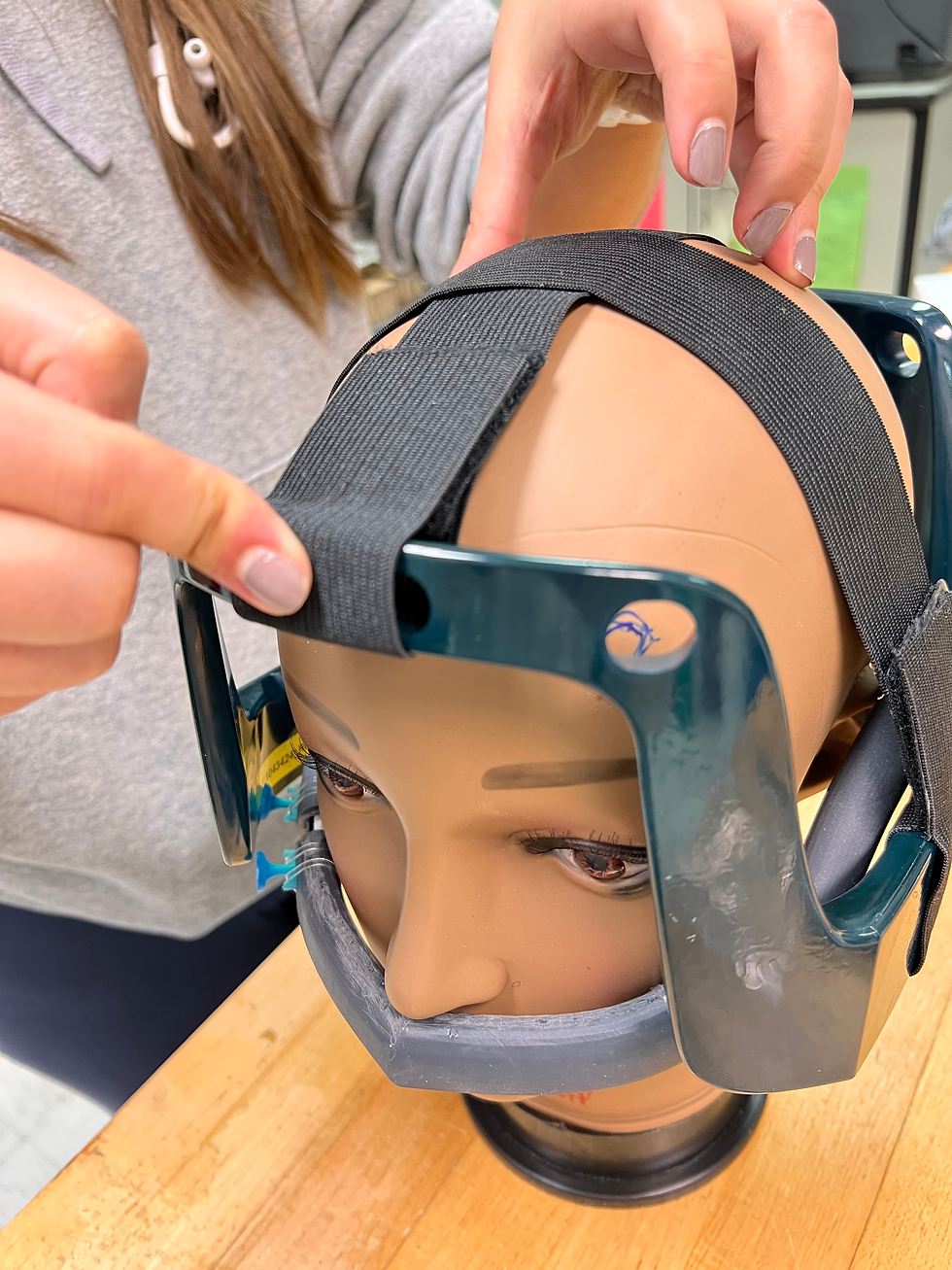


Looking forward, I believe there are multiple areas to improve upon. The landmark contact point is soft and doesn't support the adapter vertically as much as we wanted. By possibly moving it to the nose bridge or the bones behind the ears, there could be a more solid point of support. Additionally, different materials would probably need to be explored for better strength and flexibility. Lastly, while the adapter fit our faces and the mannequinns', we shoud create a bigger and smaller option with their own adjustment ranges

Clinical Validation
"In my opinion, Kelsey and Brandon managed to develop an innovative, effective design in a short amount of time. Their design directly addresses one of the core challenges they were asked to address, which was to develop a method to stabilize a stereotactic frame system to make it easier and more repeatable for a neurosurgeon to apply the frame to a patient in an OR setting."
- Dr. David Schlesinger